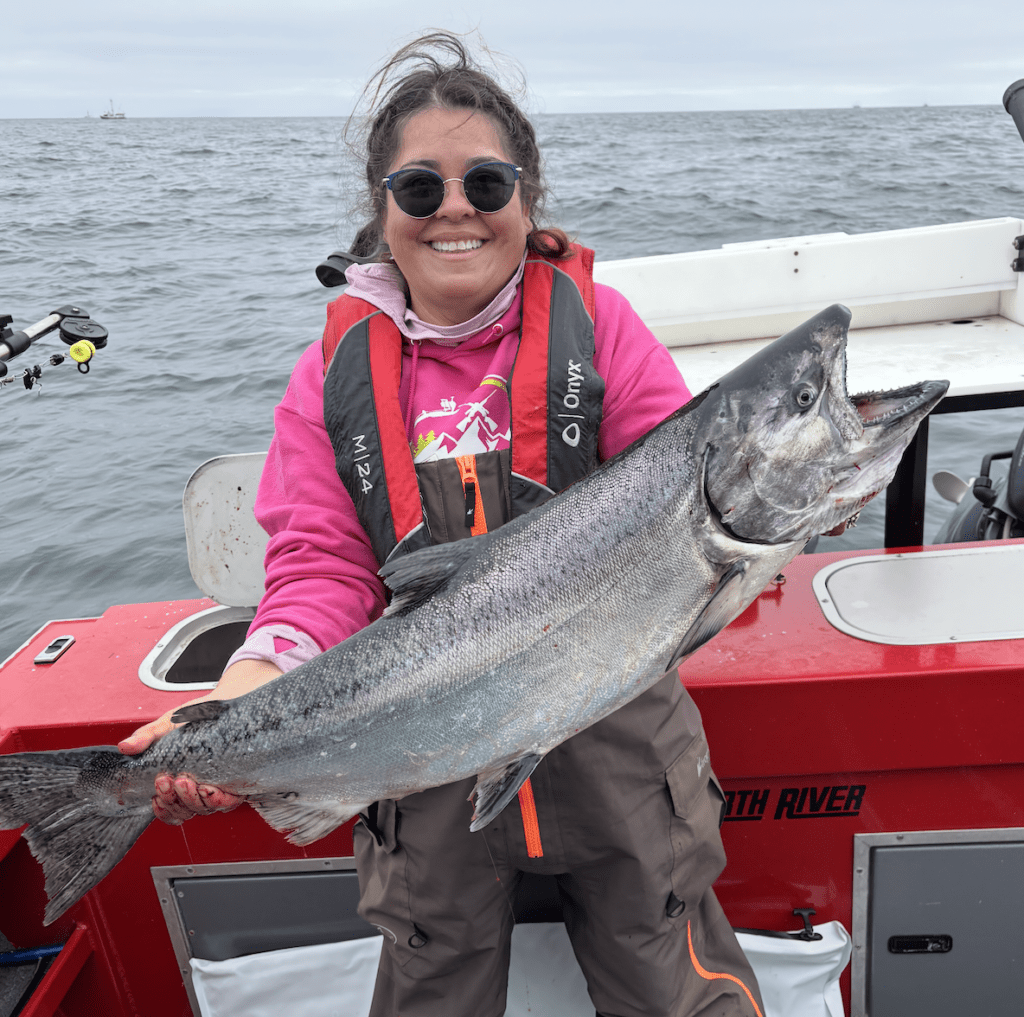
Guess who’s back at it again?!? Yup, it’s me, and I’m bringing you updated information on the North of Falcon process that is just getting our 2026 salmon season going!
As usual, there’s a lot to cover, but before we get into the nitty-gritty details, let me give you an overall synopsis of what went down in Olympia on February 27th, 2026, and at the end of this article, some good old-fashioned pessimism and alarmism from yours truly.
The Summary of Salmon forecasts for 2026
We can expect that 2026 will feel similar to recent years regarding the number of salmon returning to the Puget Sound, Columbia River, and the Washington Coast. There will absolutely be differences in a few systems impacting a few species, but for most folks, their fishing habits and plans are likely going to be intact for another year.
Last year, we had a big scare at the beginning of the process regarding coho due to the low forecasted abundance of mid Hood Canal stocks, and we don’t have anything like that at this point in the process in 2026. Will something show up later on? It does every year, but at least from a starting point, we are in a good place.
What about chinook though? The department didn’t have their Chinook NALF (new abundances last year’s fisheries) run ready yet, which would tell us where the problem areas are, and that is most likely bad news. However, if we look at the forecast comparisons, they are similar enough to last year to expect similar challenges and likely similar seasons.
But you might say, “That’s no good! Chinook fishing has been massively constrained recently!” And you would be right to say that. Marine Area 7 folks are likely still going to get screwed in terms of time on the water due to the Stillaguamish stock of concern. There will likely again be 1000 boats fishing in Marine Area 9 for only a few open days, and the same goes for Marine Area 10.
Do you want me to tell you that these are going to be referred to as the “good ole days” soon? Because I’ve got some predictions later on that, if true, are going to be quite problematic for us down the road.
Am I being dramatic? Perhaps. And it’s pretty easy to find pessimism these days regarding salmon fishing opportunities, but I have my reasons…Keep reading.
What can I expect chinook salmon fishing to be like in 2026?
What can YOU expect? Probably to catch 1 or 2 chinook salmon. The department shared that’s the typical annual catch for most anglers when discussing ideas like limiting the total annual number of chinook caught in a given year.
But if you are reading this website, you are going to catch MORE than the typical angler, amirite?!?
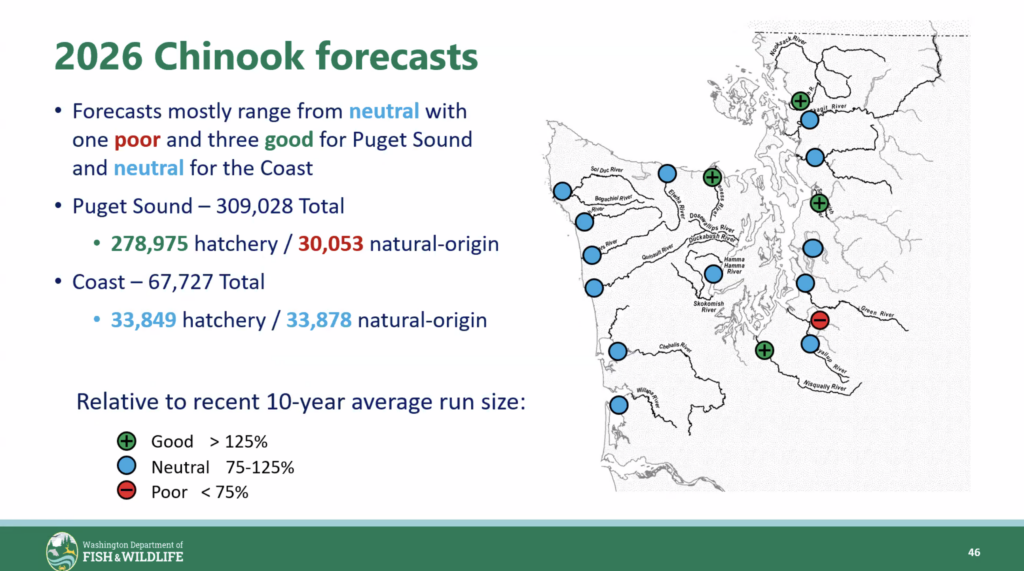
Let’s break the forecasts for Chinook in Washington State down by each area, starting with the Puget Sound.
Puget Sound Chinook Forecasts in 2026
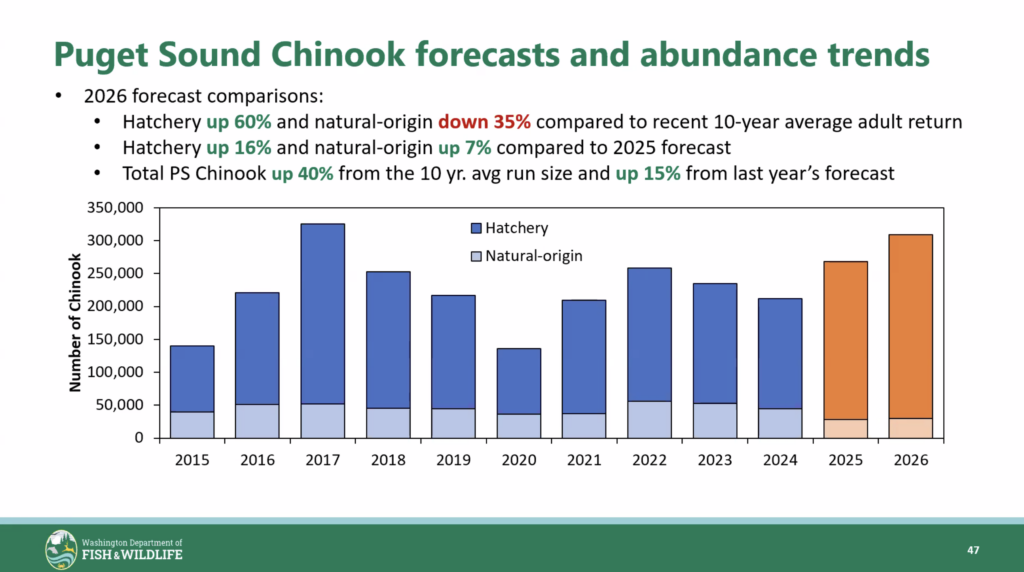
In terms of the forecast for total returning chinook salmon to Puget Sound, this appears to be the 2nd best on record for the past decade or so!
What about the problematic rivers that constrain our seasons, though?
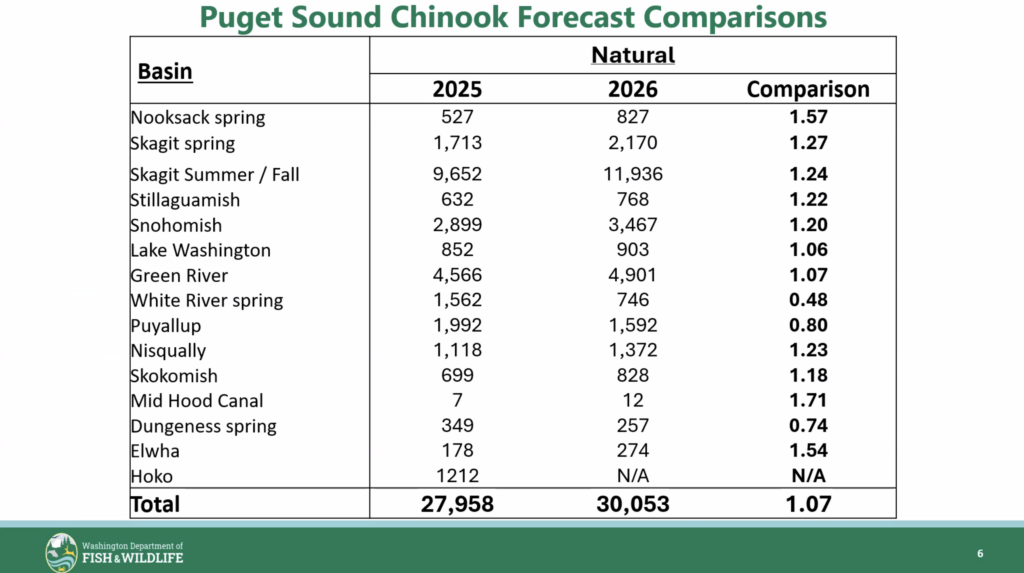
These numbers are decent relative to last year, if not for a few concerns. Seeing the Stillaguamish and Snohomish systems both up roughly 20% year-to-year is good, though it likely won’t result in much more angling opportunity. The good news is that it’s not forecast to be worse.
I’m concerned about the White River spring stock expected to be down by more than 50% year-to-year. This could impact the June MA11 fishery that occurs right out in front.
What about the hatchery stocks that indicate where fishing might be the best?
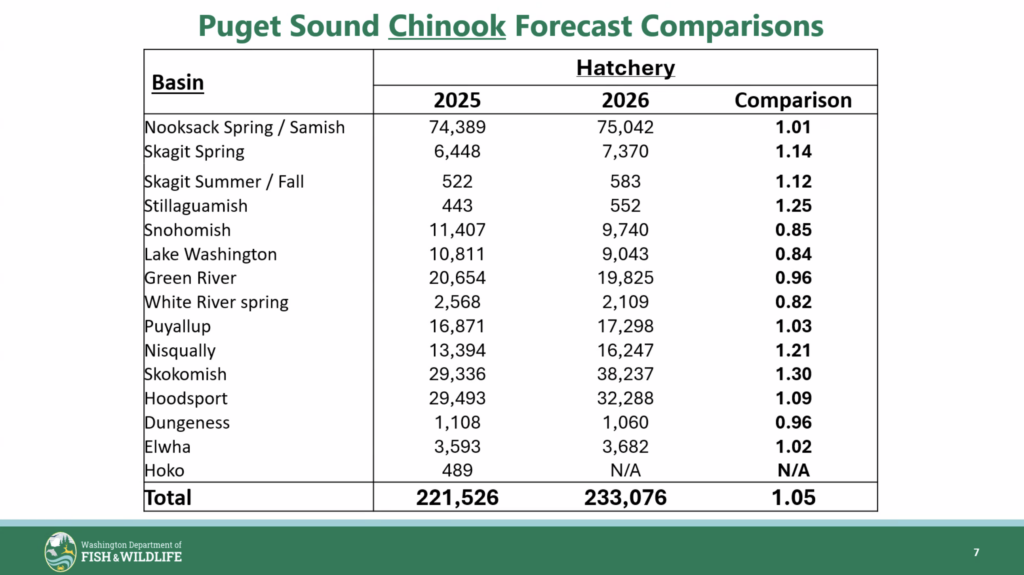
The South Sound and Hood Canal look like promising places to target chinook in 2026 based on these numbers. All of the common migration routes along the way will be promising as well, with whatever seasons we get in 9 and 10.
As usual, the further outside places like Marine Areas 4, 5, and 6 should be good as well.
These are strong numbers of returning hatchery chinook predicted!
Washington Coast Chinook Forecasts in 2026
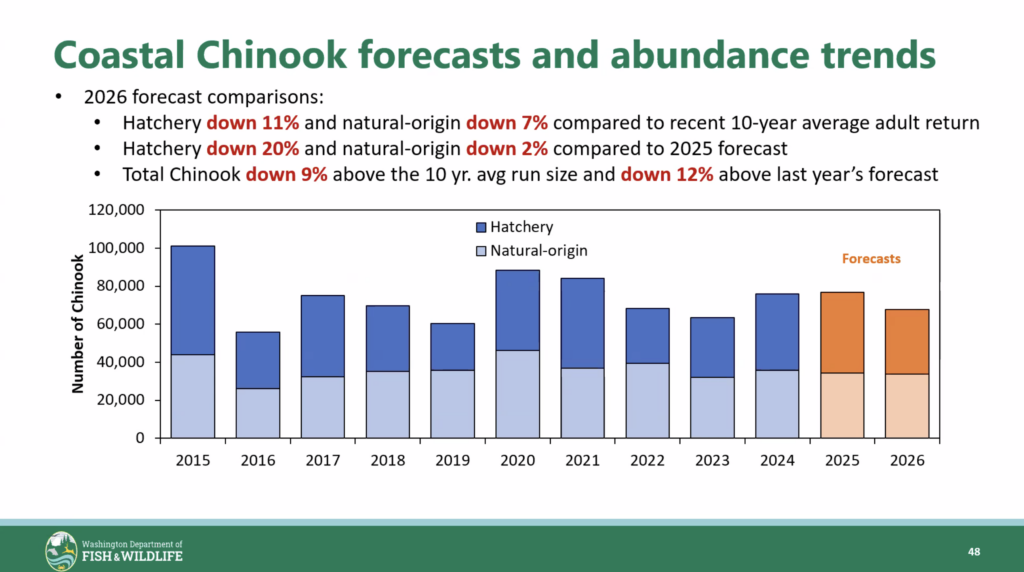
If you prefer to stomp in waders around a coastal river in the early fall, you will likely expect similar seasons as the last few years. Here’s the breakdown by river system from the PFMC tables:
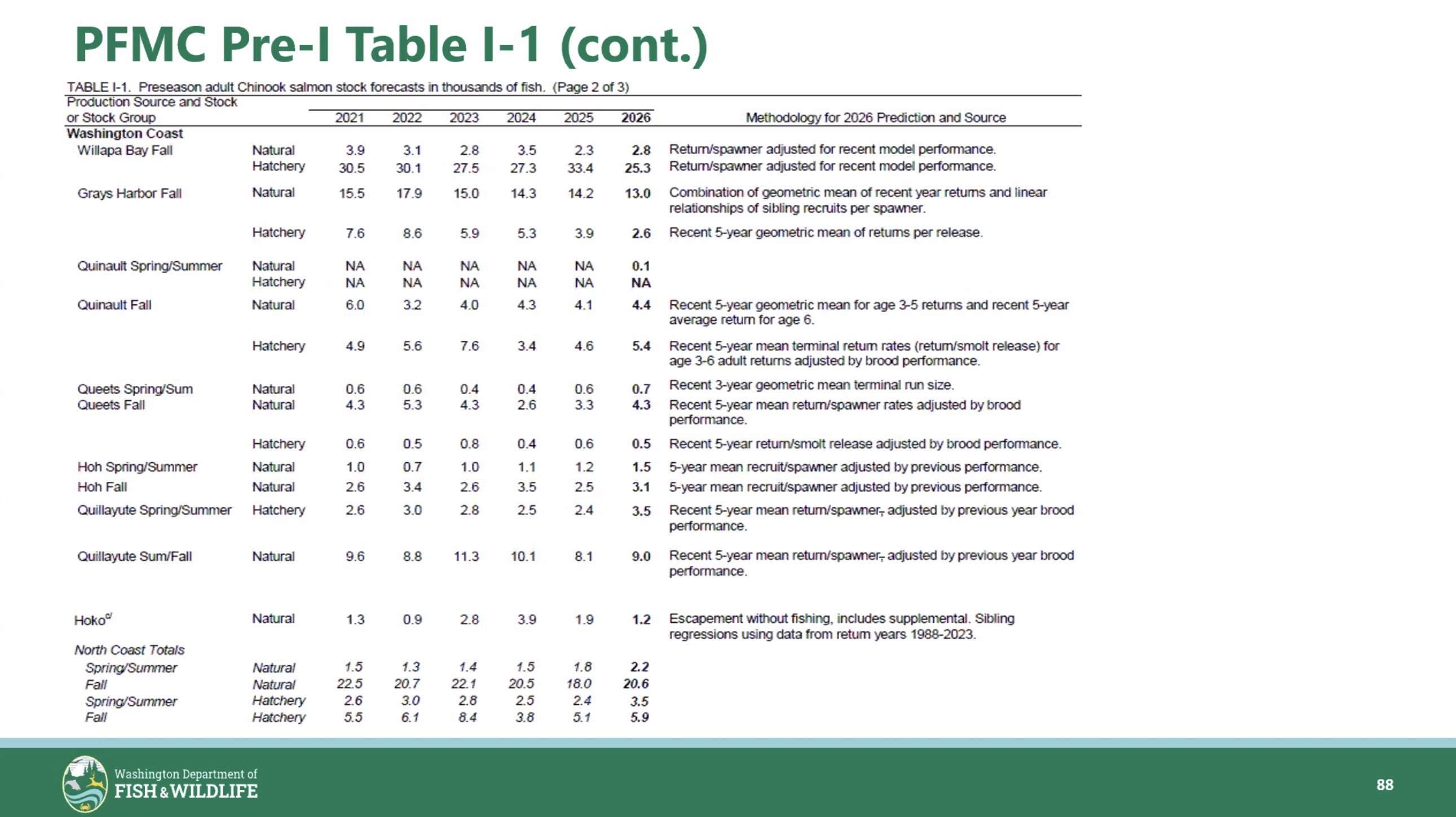
If you squint, you might be able to read that table and conclude that there’s nothing too crazy to get excited or worried about on the horizon for 2026. Just some more opportunity to drain some bobbers!
Columbia River Chinook Forecasts in 2026
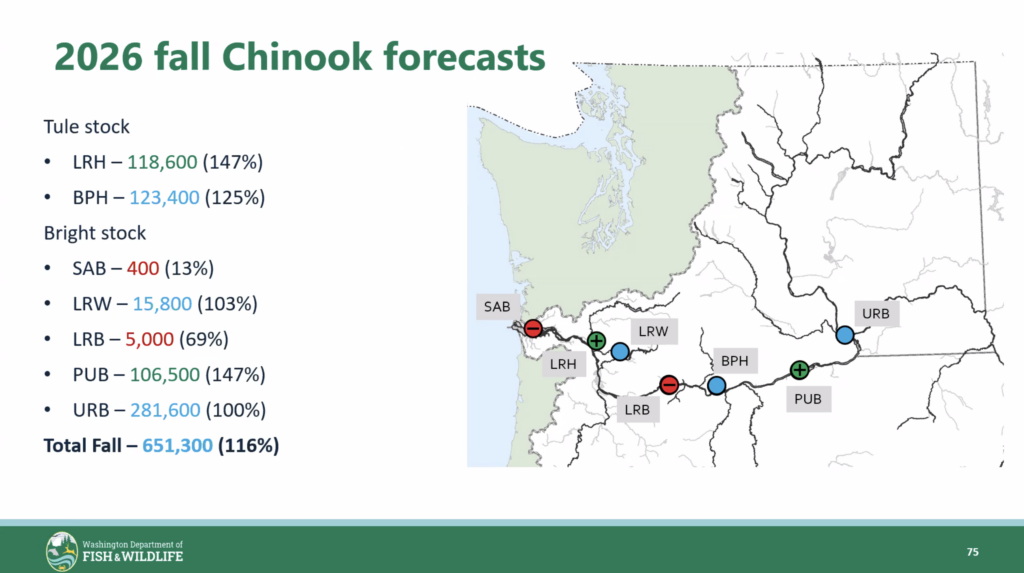
Some of you may not fish the Columbia River at all, and that’s okay, but the fall forecast for the big river basically defines what we can expect in Marine Areas 1-4. Overall, things look solid.
Here’s what the historical run-size looks like for comparison:
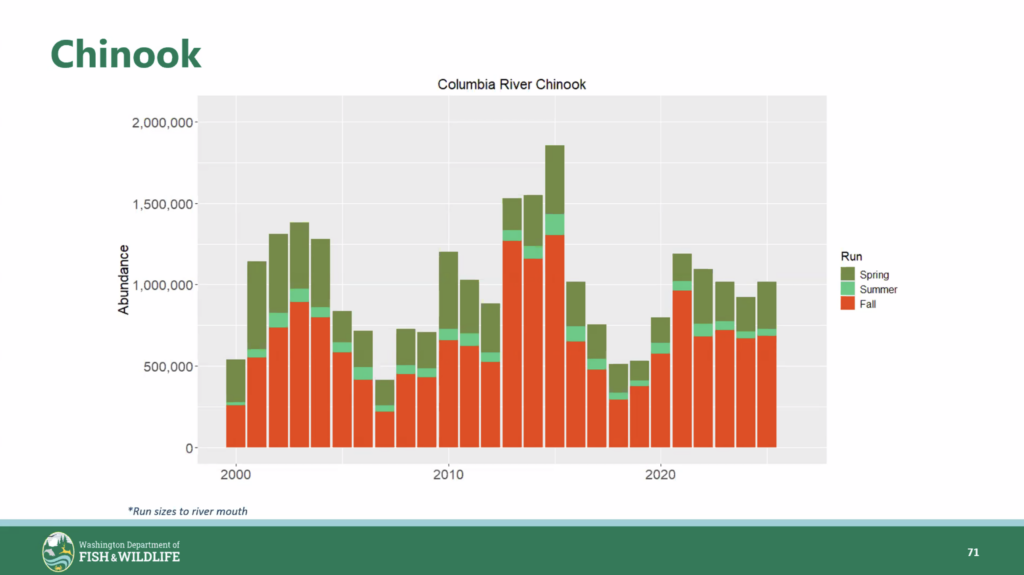
With an expectation for 651k fall fish (the red bars), you can see it’s very similar to where we’ve been in recent years. This has resulted in really good fishing out of places like Westport, Ilwaco, and the like.
What can I expect coho salmon fishing to be like in 2026?
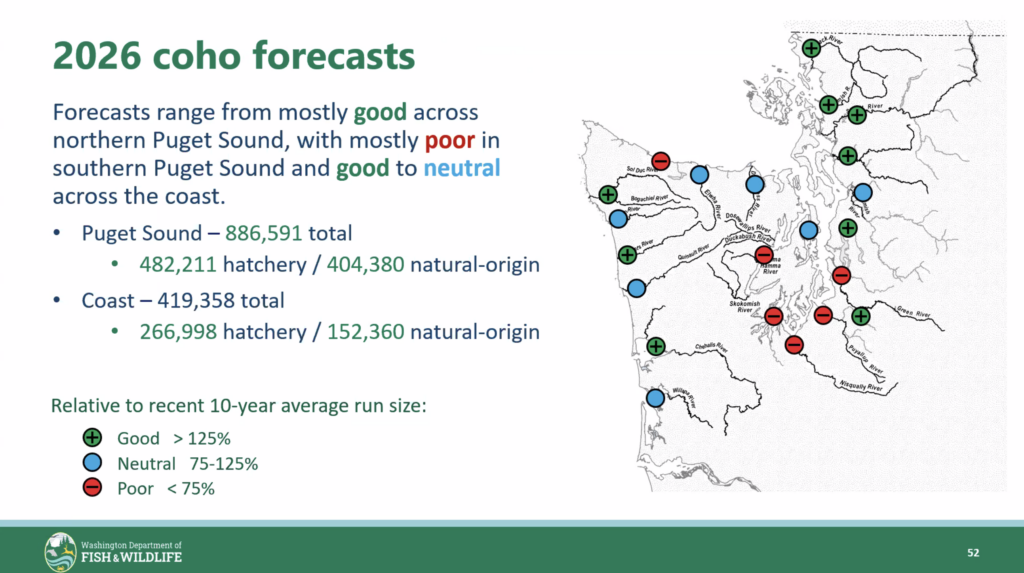
Excellent. Absolutely stupendous and fabulous! The best!
Okay, that might be a little bit extreme, but really, coho fishing should be better than in 2025 and be really good all throughout Washington State, except for a few problematic areas (looking at you, South Sound!).
Let’s break it down by each area again:
Puget Sound Coho Forecasts in 2026
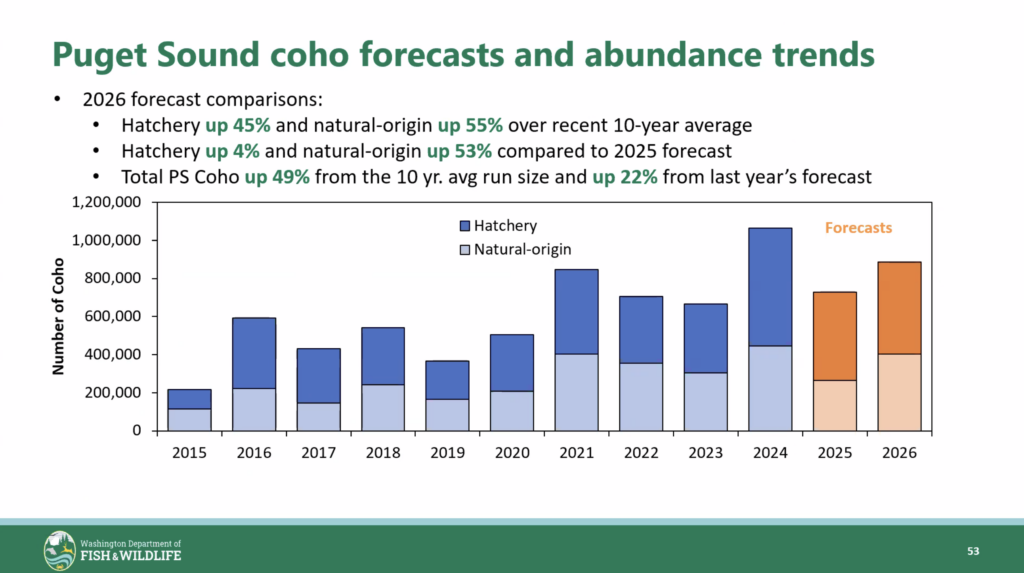
As you can see, 2026 should be one of the best seasons in recent memory based on total forecasted abundance.
But where specifically are the bright spots relative to the problem areas? Let’s start with the natural stocks:
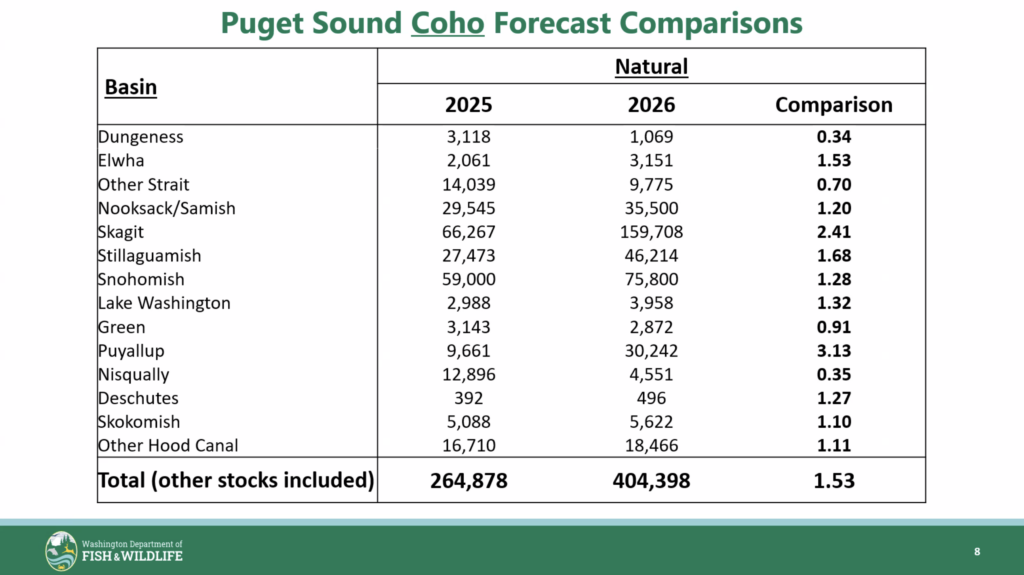
There are three things that jump out to me when looking at this table.
For one, the Skagit River is going to get a massive return of coho, meaning that fishing in places like Marine Area 9, 8-2, 8-1 should all be fantastic, as well as the river itself.
Second, the Puyallup River hasn’t seen that kind of natural coho run in quite some time. That’s my home water, so I’m expecting to spend some more time there tossing spinners and such.
Lastly, the Nisqually looks like a problem spot in 2026. Roughly a third of what returned in 2025 is expected back in 2026.
Let’s take a look at hatchery stocks now:
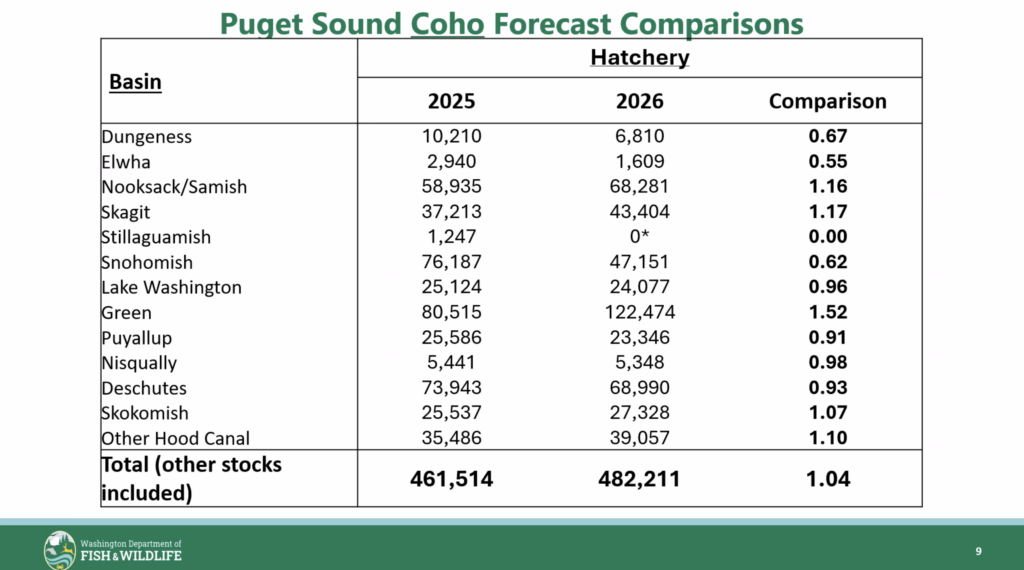
The only thing that really catches my eye in this table is the bump expected on the Green River. That should really help drive a solid Marine Area 10 coho season with the natural stock increases expected as well.
Washington Coast Coho Forecasts in 2026
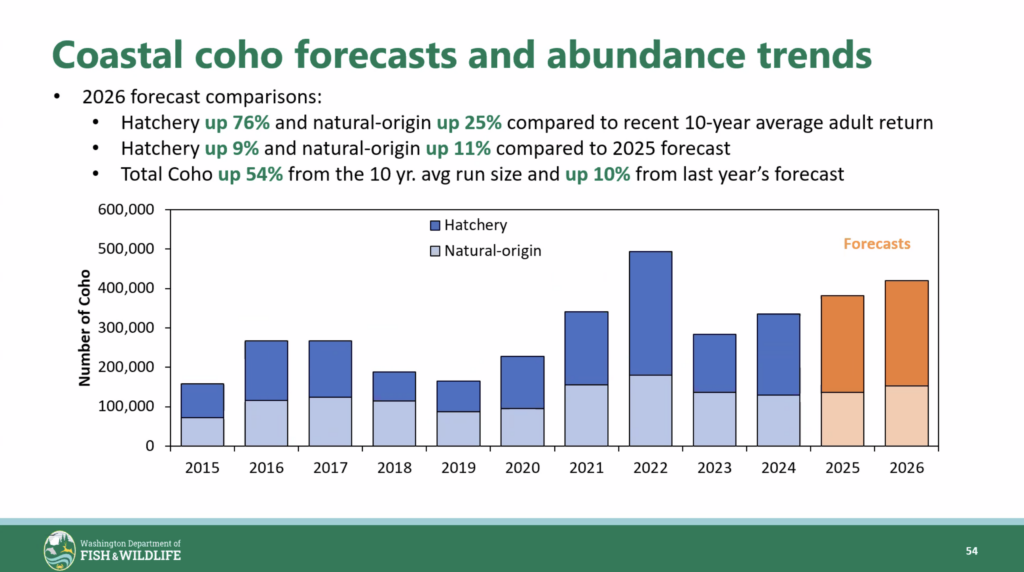
This looks like one of the better expected returns for the Washington coastal systems. Anyone excited for a little twitch, twitch, boom?!?
Are you ready for the PFMC table that will remind you that you’re not 22 anymore? Unless, of course, you are 22…And we hate you.
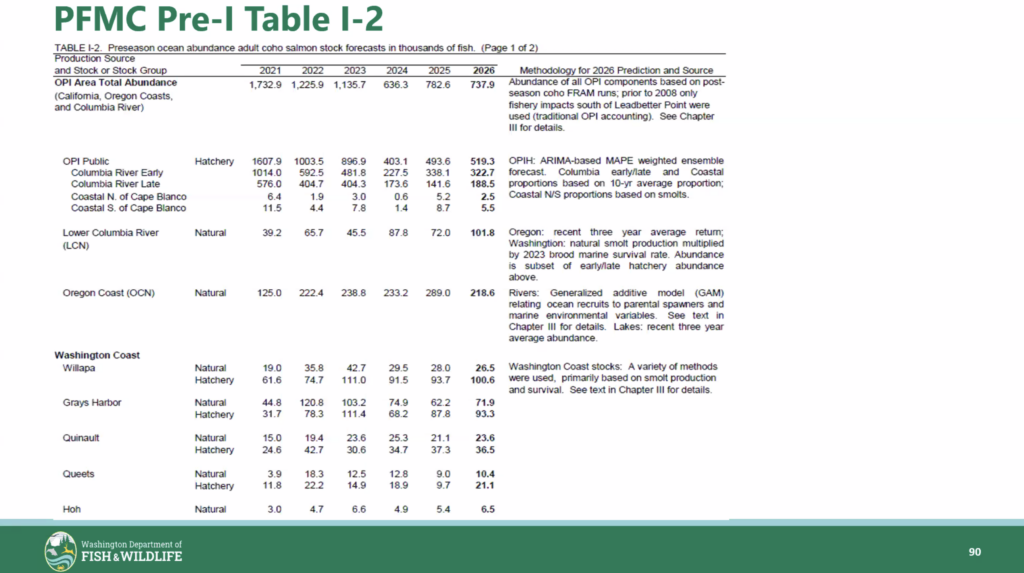
Nothing too crazy here, although the Queets looks like it’s expected to get a good bump in hatchery coho in 2026.
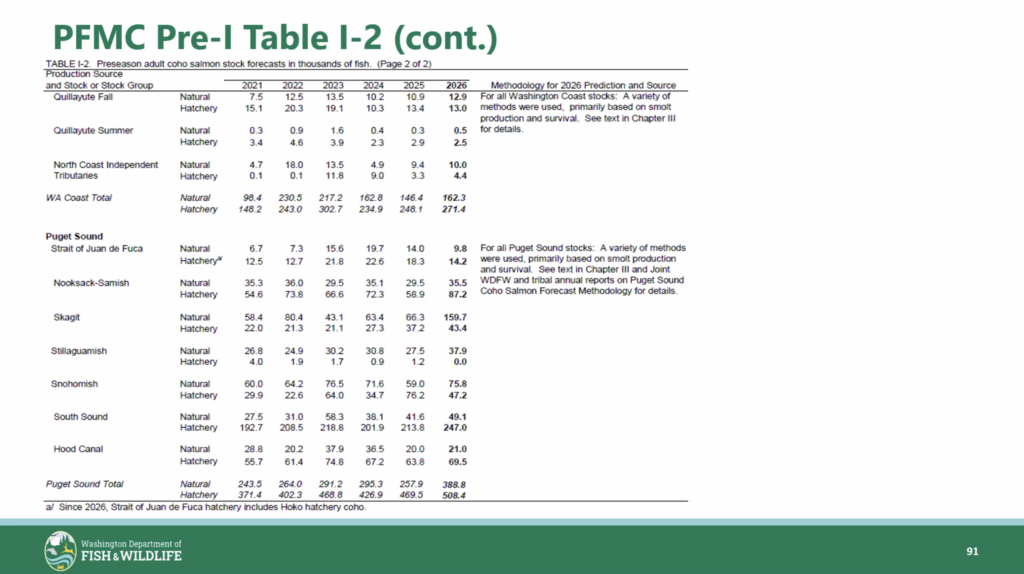
Again, nothing crazy in either direction for the remaining Washington coastal rivers.
Columbia River Coho Forecasts in 2026
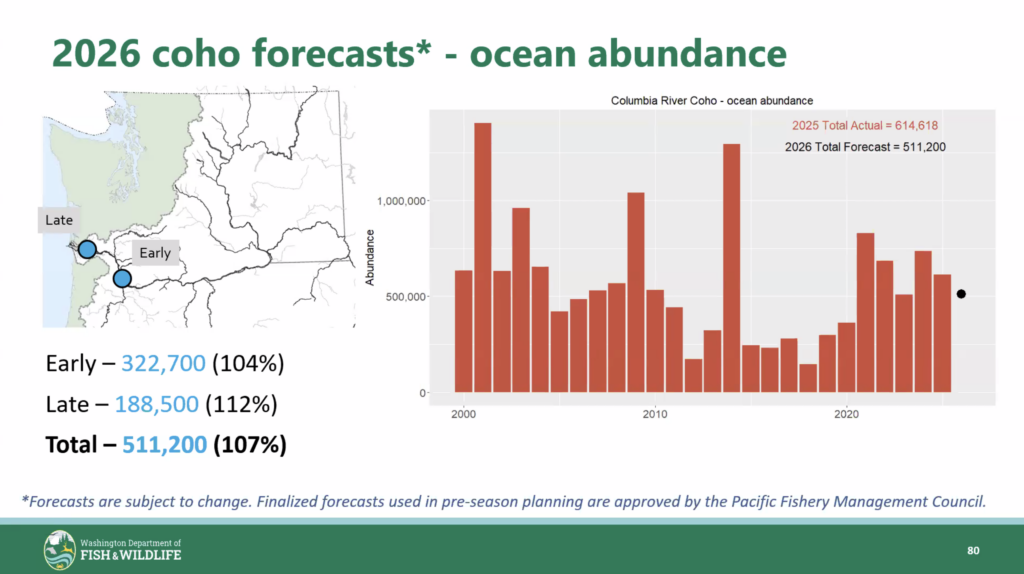
Just like we stated on the Columbia River chinook forecasts, these coho forecasts will drive ocean seasons in Marine Areas 1-4 as well.
We aren’t expecting a particularly great or down year for Columbia River coho, but more like 2025, which is sufficient to provide lots of good angling opportunity.
I would watch out for the potential for early ocean marine area closures to take place, though, as anglers tend to deplete those quotas first. Catch more ocean chinook!
What about the 2026 forecast for other species of salmon, like Sockeye or Chum?
If you aren’t tired of reading about salmon forecasts yet, you can read about sockeye and chum next. What about pink salmon, you say? Well, if you knew how to count, you would know that it’s 2026 and 2026 mod 2 is 0, which means zero pink salmon. For non-math, non-programmer nerds, new salmon anglers, the pink salmon run only shows up in odd years. So while 2026 may be an odd year, it’s definitely not odd…
Okay, enough of my sense of humor, let’s get to the forecasts by area!
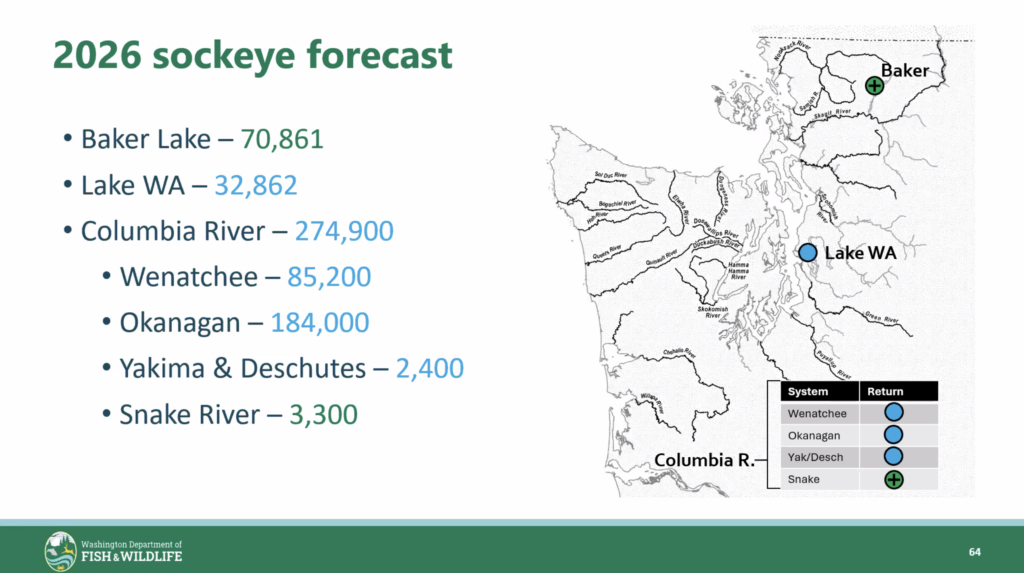
Baker Lake strong. Lake Washington… Columbia River solid.
Next!
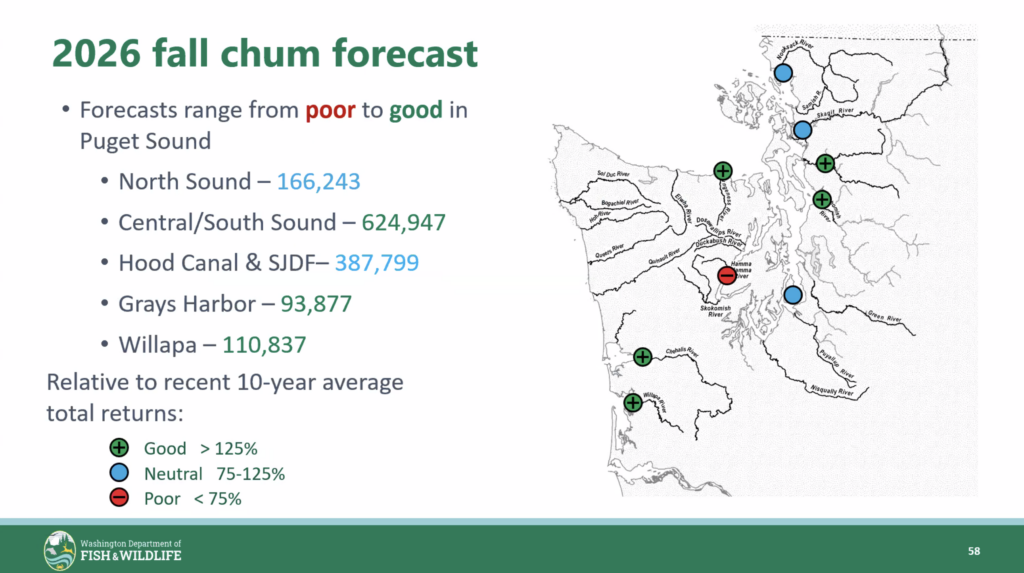
It looks like we can expect another decent return of chum in 2026 in most places. This always provides some late fall fun on a variety of rivers and marine areas.
What about your pessimism for the future of salmon?
Ahh, now we get to the juicy bits! Some off-script predictions of doom you won’t get anywhere else!
Enough of the glib sarcasm, this look toward the future is actually quite serious and sobering.
Look, salmon abundances follow natural cycles. These natural cycles of waning and waxing abundances have many factors, from climate patterns across the tropical Pacific, freshwater conditions, predator abundances, marine conditions in estuaries, all the way through the migratory feeding grounds and the spawning success of previous years’ fish, just to name a few.
It’s important to realize that our fishing opportunity on hatchery-raised chinook salmon depends entirely on the health and abundance of naturally occurring chinook.
When natural-origin chinook salmon populations fall, because of their intermingling with the hatchery salmon in fisheries, everything takes a cut to maximize the salmon that will make it to the spawning grounds.
We’ve been talking about salmon all over Washington State to this point, but I want to talk specifically about ESA listed Puget Sound Chinook.
So where are we in our abundances of ESA listed natural stocks of Puget Sound Chinook?
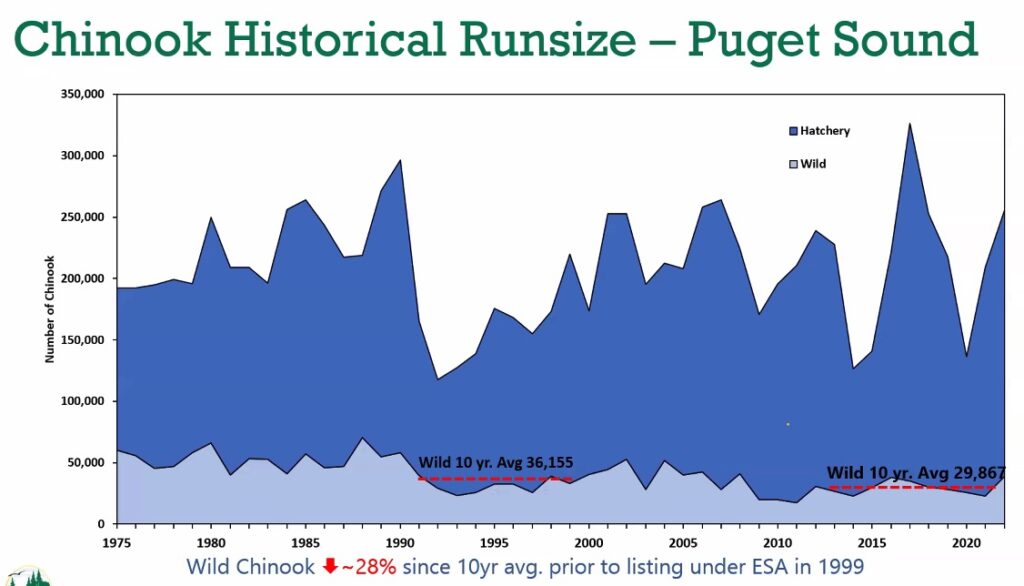
The above graph might be hard to read, and I couldn’t find one with just the natural origin Chinook listed, but you get the picture, down and to the right (light blue).
There are two vital facts to understand here about where we are at:
- Natural origin chinook in Puget Sound are near a low point in their abundance history
- We’ve just experienced some of the best environmental conditions in the last several decades for chinook salmon abundances
You might need to read those two points again.
Let’s take a look at the environment for salmon abundance in recent years:
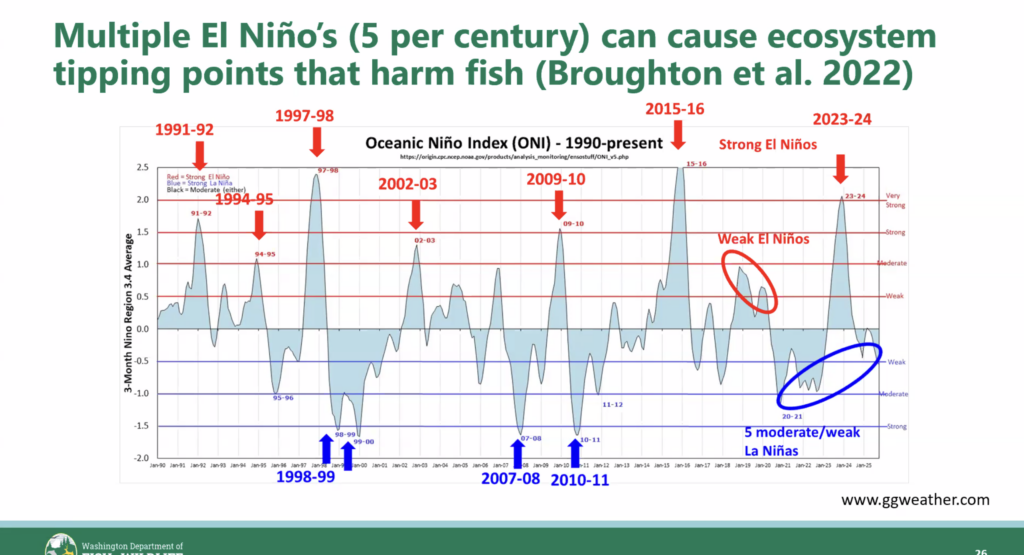
La Nina translates to wetter and cooler. El Niño means warmer and drier. As it relates to salmon abundance, El Niño bad, La Nina good. It’s pretty unprecedented to have 5 La Niñas in a decade-long window, and this has been very good for salmon abundances.
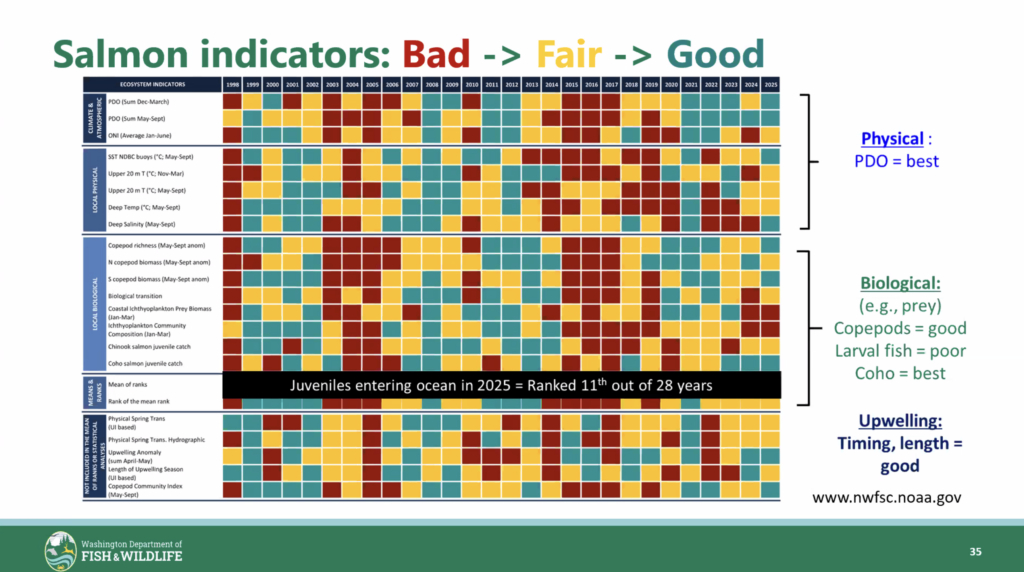
You can see from the salmon abundance stoplight chart from NOAA that the last 5-6 years have had limited reds and lots of green/yellows compared to previous periods. You can compare this to the actual returns of salmon and the tropical climate patterns graph, and see lots of correlation.
What can we expect going forward though that fills me with pessimistic notions?
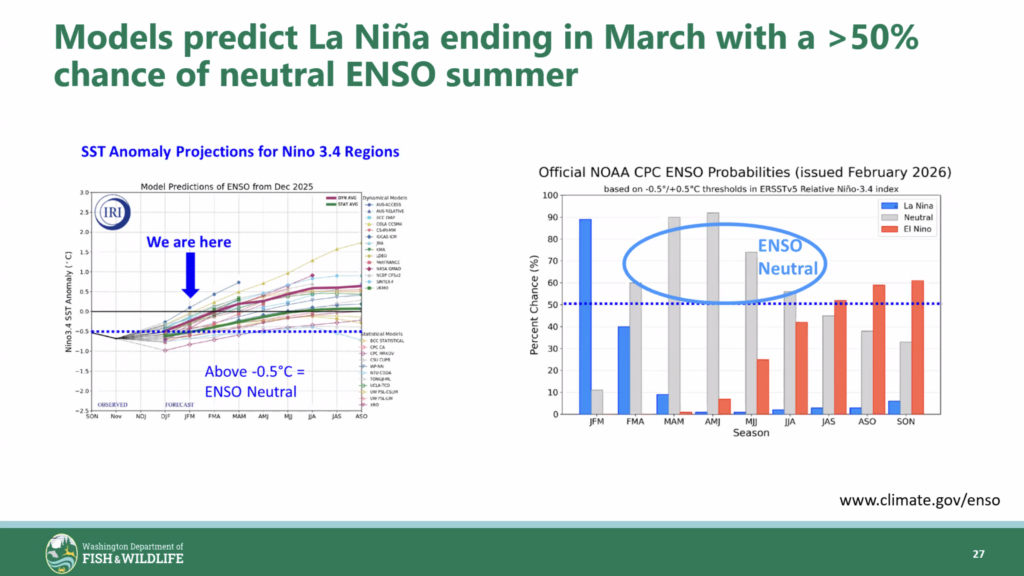
What’s predicted ahead is the inevitable environmental swing back to warmer / El Niño conditions that result in conditions that generally produce fewer salmon.
One of the points made in the environment portion of the presentation was that we are having more and more extreme weather swings. As global land and sea temperatures increase, we are spending less time in neutral and more time in La Niña or El Niño mode.
And we are due.
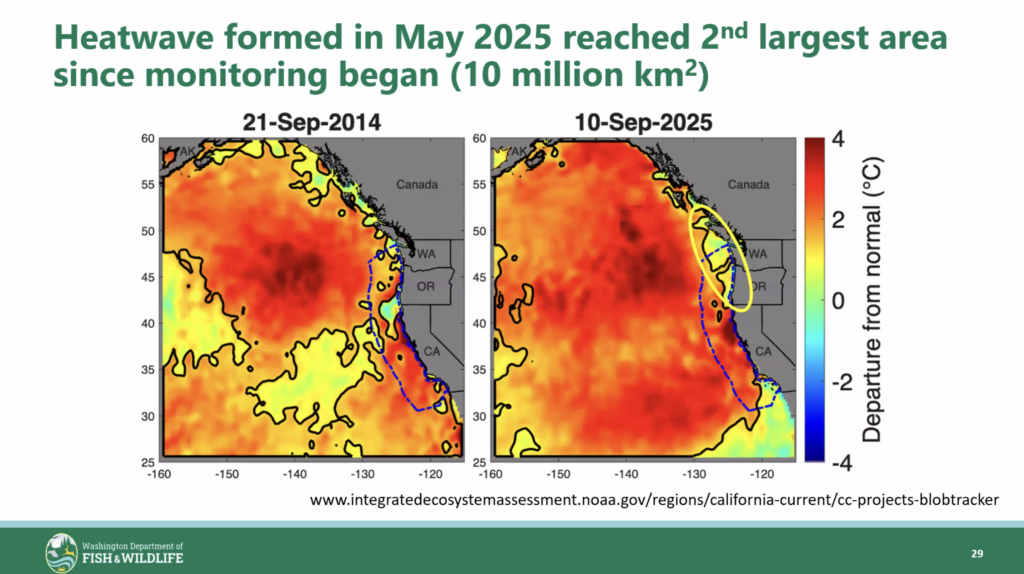
Additionally, the warming of water in the northern Pacific is of concern, which is only alleviated by the offshore winds that have allowed for enough upwelling to occur to keep sea surface temperatures conducive for salmon abundances.
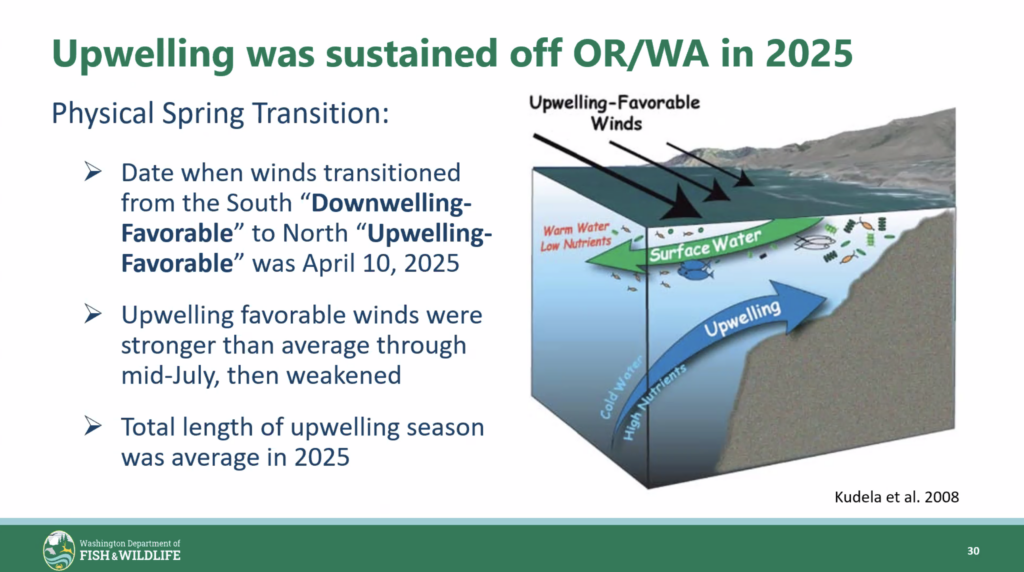
As warmer surface waters are blown offshore, they are replaced by nutrient-rich, though poorly oxygenated, deeper water that creates continued good conditions for salmon abundances.
If we have a period of weaker upwelling combined with El Niño conditions, these warm water blobs will have catastrophic impacts on marine salmon survival, like what we saw in the 2014-2016 period.
But didn’t we still get to fish in 2014-2016? Didn’t we make it out of that period okay? Yes, but that’s before the new chinook management plan went into effect, which has now capped the exploitation rate at much lower levels on stocks of concern.
What happens if natural-origin chinook populations fall off a cliff? I’m sorry, I don’t understand the question; that’s already happened!
Okay, sorry: What happens if natural-origin chinook stocks in Puget Sound that have already fallen off a cliff historically, fall off another cliff, and their numbers plummet substantially?
You can probably fill in the details as well as I can; I don’t have any special knowledge or access to data that I’m not sharing here with you all.
What can be done about this?
Enjoy your couple days of chinook fishing on Puget Sound in 2026.
No, seriously, what can be done about this?
There are quite a few structural challenges to overcome that I’ve written about considerably in the past, but here are a few reminders:
- Lethally remove salmon-eating pinnipeds (enough playing politics with the biological realities of ecosystem management!)
- Re-negotiate the Pacific Salmon Treaty to include draconian protection measures for Puget Sound Chinook stocks
- Ban or significantly reduce the non-selective harvest of Puget Sound chinook along the migration route of these salmon.
We cannot influence the weather patterns materially. If you are convinced you can, keep voting for higher gas taxes and go buy a Tesla; your grandkids may thank you.
Obviously, habitat restoration is a key factor in the mix of all of this as well, but as long as people keep moving here, I don’t expect that to do more than just hang on to the current situation.
The above 3 suggestions seem like they are harder to influence than the weather, and each has its own challenges, but the challenges are near-term and political, not longer-term.
Lethally removing the salmon-eating pinnipeds will result in significantly more salmon for all fisheries as well as more food for the endangered SRKWs. In each river system, there are a small number of seals and sea lions that go into the river and spend significant time there consuming these vulnerable, depleted resources. Most of the damage is done by harbor seals eating juveniles in the dark when there are no seasons open, and neither you nor I is on the water to observe.
Look at the Chehalis River system for a case study. There are substantial amounts of chinook that migrate back there and spawn every year, but when is the last time recreational anglers had a decent angling opportunity on them? Why is that?
Besides the fact that the historical abundances are down, it’s because the harvestable amount of chinook allowed according to the low abundance of natural origin chinook are all taken by commercial fishing in Canada and off the coastal waters of Washington. By the time these fish make it back to the river, every other interest group has taken their share of the fish, leaving none for the recreational angler.
The structure of fishing opportunity in the PNW means that when the local natural-origin stock becomes depleted, the impact is felt closest to the source and radiates out, eliminating opportunity as it goes until it reaches a point where the fish are so unlikely to be encountered that it’s merely a footnote in season calculations.
Again, let’s look at the Chehalis River: There are no river angling chinook opportunities and no political or structural ability to say, “Hey, you guys in Marine Areas 2-4 should leave us a few salmon.” The same goes for protecting Chehalis River chinook in Canadian fisheries.
I’m not even going to say that’s a bad thing necessarily. It is just the reality of what happens when a run of fish reaches low abundance. Very little opportunity will be bought back by simply cutting ocean fisheries off the Washington Coast.
So when the Puget Sound Chinook populations become significantly lower, the impact will follow the same pattern. In-river fisheries will be shut down first (Snohomish, Stillaguamish, Nooksack, etc). Fishing out in front of those rivers in places like Marine Areas 9, 10, 11, etc will be shut down, just like we’ve seen with the Stillaguamish and Marine Area 7.
Fishing will further be reduced along the migration route, and all the available impacts on our ESA-listed salmon will be spent on commercial fishing opportunities off of Washington waters and Canadian fisheries. Keep in mind that while this is going on, you can pop over to Canada with a valid Canadian license and kill 2 ESA-listed Puget Sound chinook per person.
And because of the economic/political factors, Puget Sound anglers won’t even have a seat at any table where these things are discussed and decided.
I asked one question during the North of Falcon forecast kickoff meeting:
I’m concerned about the status of ESA-listed chinook; they are historically depressed, and we just had several great years of good environments favorable for salmon returns. Heading into a potentially challenging warming cycle is concerning for these natural stocks.
PS chinook are at the end of a long chain of fisheries impacts from WCVI, Outside fisheries.
In looking at FRAM data, some of our most critical limiting stocks get 50% of their natural stock impacts from non-selective fisheries outside of those Canadian fisheries via commercial fisheries prosecuted in the SUS.
What are the plans or approach to advocate for lowering the impact to PS natural stocks in the 2026 process as input to the ocean PFMC process, or even the PST renegotiation?
Will ESA listed PS Chinook be fairly represented in these outside processes, given the forecasts and what’s ahead?
The answer from the department was ho-hum about the usual processes taking place. I didn’t hear any shared alarm or concern, just numb professionalism, no personal passion for protecting these fish, just business as usual. Perhaps there’s a plan in the works that I’m unaware of. Perhaps this is all alarmism for nothing. Perhaps.
Are you ready for the rest of my pessimistic take?
When angling opportunity dwindles, so does the interest. Acceptance of the “new normal” sets in. 21st-century life is filled with pressure, noise, and distractions. We will be mad, but eventually, just like the fish, we will go away.
2026-2027 may be the last chance to make any kind of notable difference. The last chance to create enough noise while public interest is still high, before moorages go away and boats are sold, and people structurally move on with their lives in other directions. When we say, “Remember the good old days when we used to get 5 days of chinook fishing in Marine Area 10?”
The Pacific Salmon Treaty expires in 2028, and renegotiations are to begin soon. Will Puget Sound chinook be a factor?
I wish I could tell you exactly where to spend your energy to make a difference, but the one thing you can do is get involved in North of Falcon. There are a few more public meetings. There are open-to-the-public commission meetings.
Too busy to attend a meeting? There are public comment portals to leave feedback. Make the message clear: “We are concerned about the health of Puget Sound natural-origin chinook stocks, and that our ability to fish for chinook salmon in Puget Sound may be on the cusp of a major down cycle.”
- Pinnipeds and predators – What’s the department’s plan for ecosystem balance?
- Pacific Salmon Treaty – More protections for Puget Sound chinook, stop/minimize non-selective fishing along the migration route in Canadian waters.
- More protection for Puget Sound chinook in Washington waters, stop/minimize non-selective fishing along the migration route
What if we went down swinging? What if we gave it all we had one more time? I’m not talking about just you, the guy or gal that fills your punch card every year with chinook, I’m talking about YOU, the person who fishes Puget Sound a few times a year.
There are many more of you than there are of us who spend much more time at it and are often already involved. But we all dream of being able to catch a whiff of the pungent odor from a fresh purple-backed chromer missing a fin being brought on board.
We need your help! Yes, you, the one who struggles at the launch at 4 am because you only do this a few times a year. The one who buys 30 different flashers and spoons but only uses the one you caught that one fish on that one time (oh wait, that’s me too).
Many thousands of you (tens of thousands?) have read my website or watched my YouTube over the years, which is devoted to helping you catch that “fish of the year.”
Get involved. Show up. Be respectful, but don’t go down quietly.
Have a wonderful 2026 Washington State salmon season.
Nice work, Kyle. Very informative (and motivating) post!